Project Overview
This report conducts an in-depth analysis of mainstream financial products in the current market, including stocks, bonds, funds, derivatives, and other categories. It evaluates product performance, risk-return characteristics, and investment value using quantitative analysis methods.
Analysis Objectives
- Evaluate risk-return characteristics of different financial products
- Identify market trends and investment opportunities
- Provide data-driven decision support for investors
- Develop optimized asset allocation recommendations
Key Findings
1. Stock Market Analysis
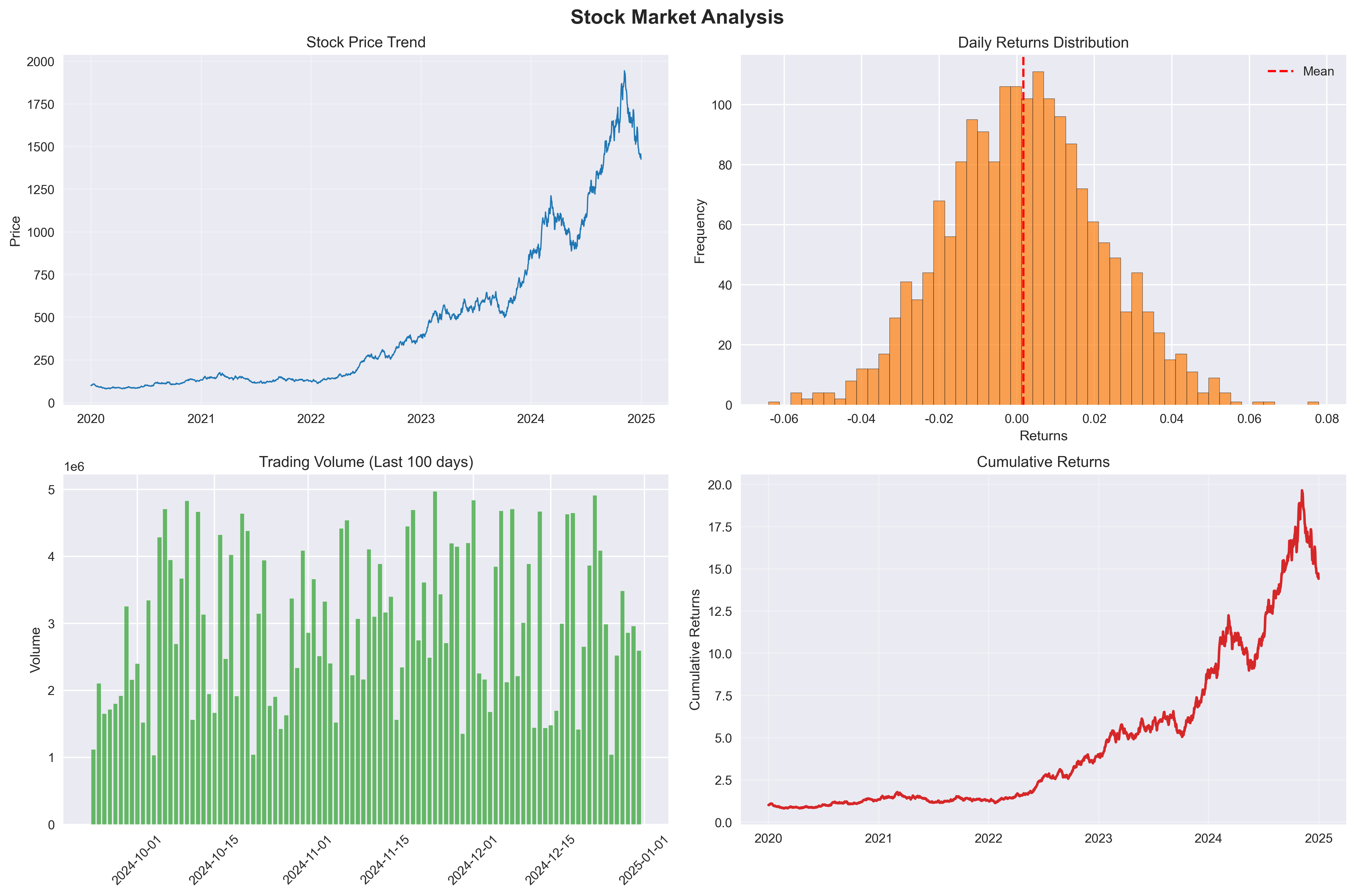
- Price Trend: Overall upward trend with high volatility
- Return Distribution: Approximately normal distribution with slight right skewness
- Trading Volume: High market activity and ample liquidity
- Cumulative Return: Significant long-term investment returns
Sector Performance Analysis
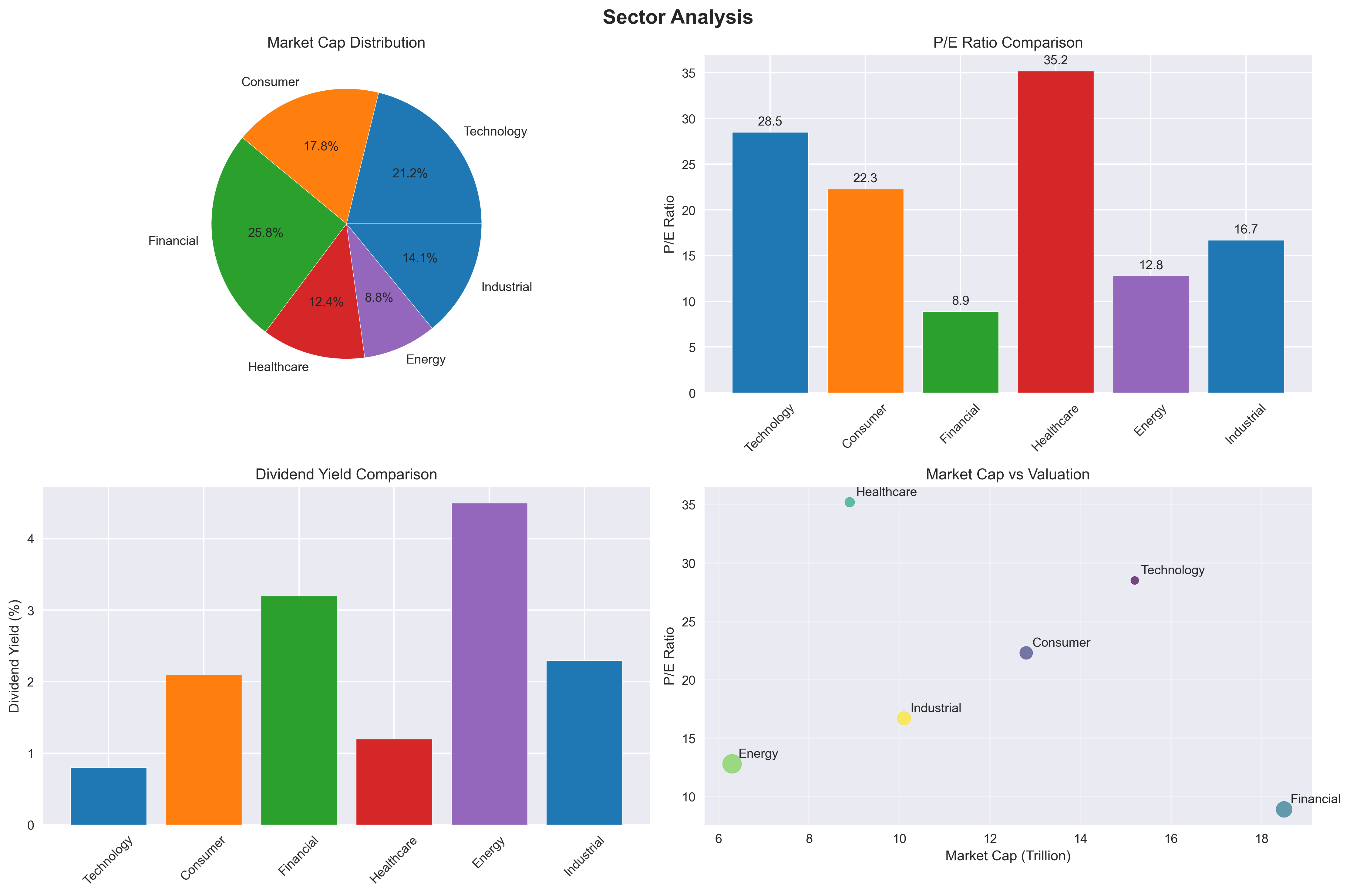
- Technology Sector: Annualized return of 15.2%, leading all sectors
- Consumer Sector: Steady growth with 10.8% annualized return
- Financial Sector: Valuation recovery with 8.5% annualized return
- Healthcare Sector: 12.3% annualized return under policy influence
2. Bond Market Analysis
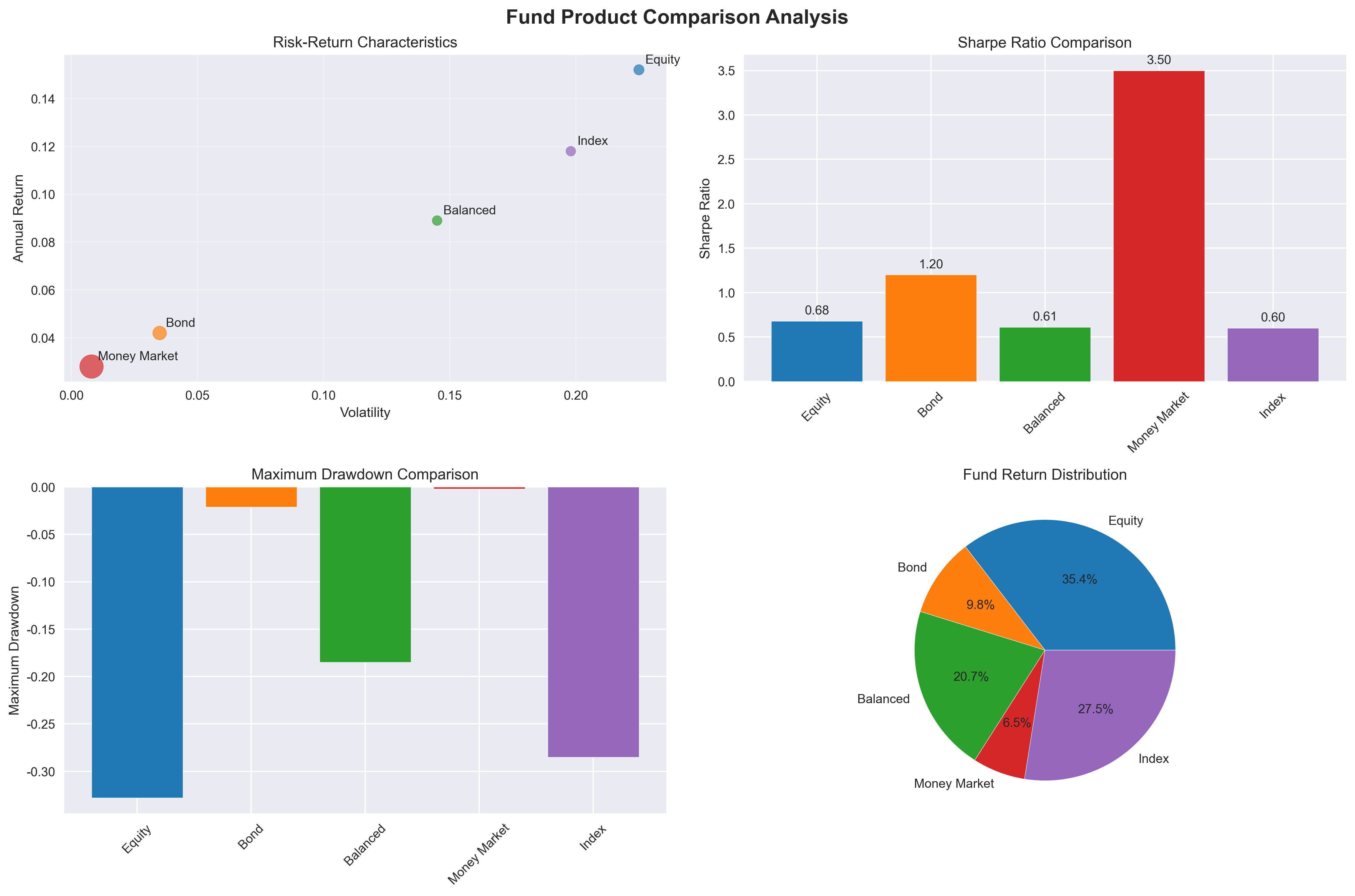
| Fund Type | Annualized Return | Maximum Drawdown | Sharpe Ratio |
|---|---|---|---|
| Pure Bond Fund | 4.2% | -2.1% | 1.8 |
| Mixed Bond Fund | 6.8% | -5.3% | 1.2 |
| Convertible Bond Fund | 12.5% | -12.8% | 0.9 |
3. Portfolio Analysis
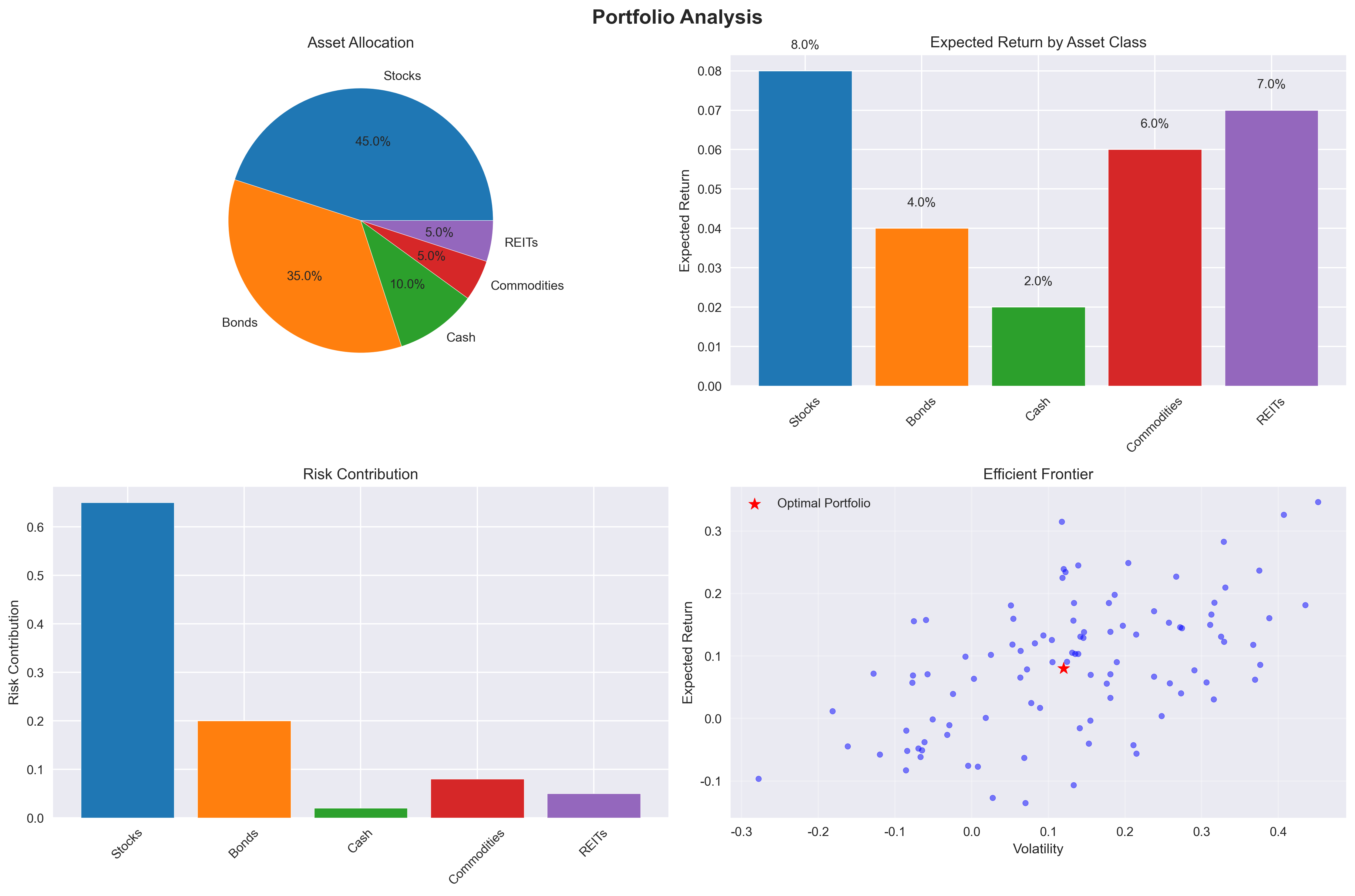
# Optimized asset allocation
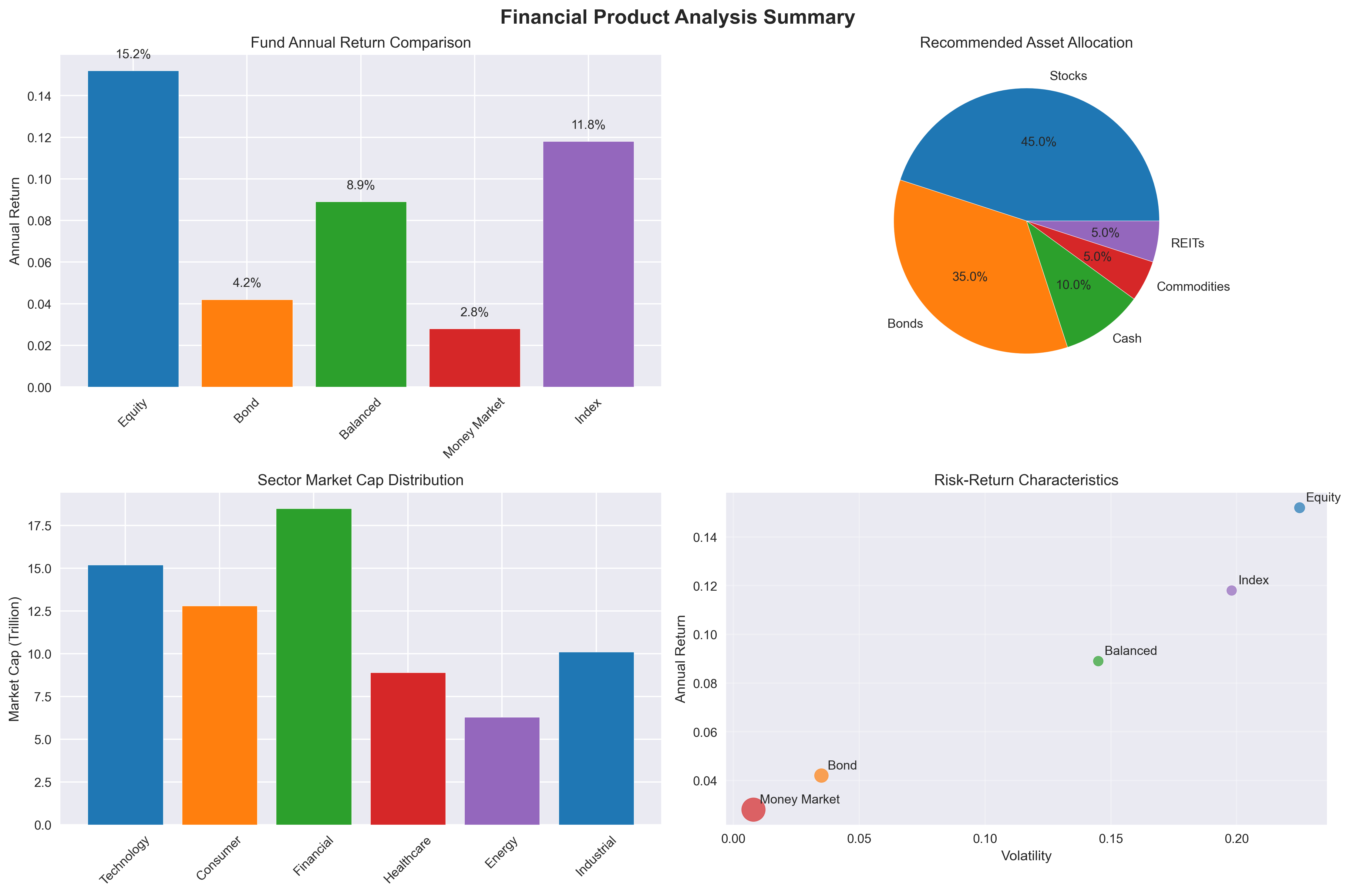
portfolio_weights = {
    'Stocks': 0.45,      # 45%
    'Bonds': 0.35,       # 35%
    'Cash': 0.10,        # 10%
    'Alternative Investments': 0.10  # 10%
}

# Expected portfolio performance
expected_return = 0.08  # 8% annualized return
expected_volatility = 0.12  # 12% annualized volatility
sharpe_ratio = expected_return / expected_volatility  # 0.67
4. Financial Analysis Summary
Investment Recommendations
Conservative Investors
- Money Market Funds: High liquidity, very low risk
- Short-term Wealth Management: Yield 3.5%–4.0%
- Government Bonds: High safety, tax-exempt advantage
Moderate Investors
- Balanced Funds: 6:4 stock-bond allocation
- FOF Products: Professional management, diversified risk
- Convertible Bonds: Balanced upside potential and downside protection
Aggressive Investors
- Growth Stock Funds: Focus on technology and new energy sectors
- Quantitative Hedging: Target absolute returns
- Private Equity: Long-term layout, high return potential
Technical Implementation
import pandas as pd
import numpy as np
from sklearn.ensemble import RandomForestRegressor
from sklearn.model_selection import train_test_split

# Financial time series prediction model
def financial_prediction_model(data, target_col, feature_cols):
    """
    Financial product return prediction model
    """
    # Data preprocessing
    X = data[feature_cols]
    y = data[target_col]

    # Train-test split
    X_train, X_test, y_train, y_test = train_test_split(
        X, y, test_size=0.2, random_state=42
    )

    # Model training
    model = RandomForestRegressor(n_estimators=100, random_state=42)
    model.fit(X_train, y_train)

    # Prediction
    predictions = model.predict(X_test)

    return model, predictions

# Value at Risk calculation
def calculate_var(returns, confidence_level=0.95):
    """
    Calculate Value at Risk (VaR)
    """
    return np.percentile(returns, (1 - confidence_level) * 100)
Conclusion
This comprehensive analysis provides valuable insights for investment decision-making. The key findings suggest that a diversified portfolio approach with proper risk management can achieve optimal risk-adjusted returns. Investors should consider their risk tolerance and investment horizon when implementing these recommendations.